Smoke on the Sixth: Bonfire Night and the Folk Horror We Perform Every Year
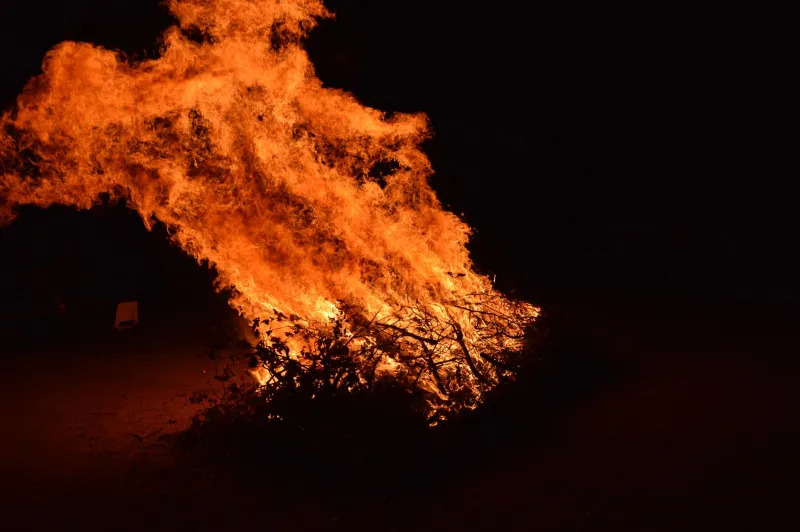
There's a smell that only exists on the morning of the sixth of November: wet charcoal, scorched grass, a thread of gunpowder still hanging in the cold. The garden looks like something happened in it. Maybe something did.
The night before, the whole street stood in the dark and watched a human shape burn, and everybody agreed in advance that this was fine, wholesome, traditional, and suitable for children. That's not a horror film. That's a horror film's premise, endorsed by the local council.
An effigy is an argument you can set fire to
Start with the guy. A pair of old jeans, a stuffed bin bag, a pillowcase for a head, a mask from a supermarket multipack. Dragged around in a wheelbarrow for a fortnight. Then, on the night, placed carefully at the top of a pyramid of pallets and set alight while someone's dad does health and safety with a torch.
Effigy logic is old and it is not subtle. You make a likeness and you destroy the likeness to destroy the thing it stands for. Sympathetic magic, in the front garden, with sparklers.
The Wicker Man understood this so completely that it built an entire film around the final arithmetic of it — the effigy that is also a person, the community that has decided in advance, the songs sung while it happens. Summerisle is only doing at scale what Britain does every autumn with less theology and more sausage rolls. The impulse is identical. We just don't dress it up as religion any more, which arguably makes it stranger.
The night the country consents to misrule
Halloween gets the folk horror branding because it's imported and spooky and easy to sell, but the 5 November is the one that's genuinely ours, and it's far less containable.
Lewes is the obvious case. Seven bonfire societies, torchlit processions, burning crosses, the whole town sealed off, and effigies not of Guy Fawkes but of whoever has irritated the town that year — an annual editorial in papier-mâché, decided in a committee room and settled by fire. It isn't a re-enactment. It's a verdict.
Then there's Ottery St Mary in Devon, where lit tar barrels are carried at a run through packed streets, and has been for centuries. Nobody could insure it if it were invented today. It survives precisely because it isn't invented — it's inherited, and inheritance is the one thing bureaucracy can't argue with. This is licensed transgression: exactly one night a year when fire, crowd and dark are permitted to occupy the same space.
Folk horror's standard engine is the village that has agreed on something the outsider finds appalling. On bonfire night, that village is every village.
Everyone is complicit, and that's the horror
What makes The Wicker Man bite isn't the fire. It's the politeness. Sergeant Howie is not chased; he's hosted. There's a maypole, a procession, a bit of admin, a landlord who keeps pouring. The horror is that the community is organised, cheerful and entirely in agreement.
Now look at a village hall bonfire. There's a committee. There's a raffle. There's a bloke with a clipboard and a hi-vis vest doing the fireworks, and a rota for the tea urn. The most terrifying sentence in British folk horror — it's all been arranged — applies equally to a pagan sacrifice and to the parish bonfire society.
We watch from the boundary rope with a paper cup of soup and we are, all of us, part of it. That's the bit the films keep trying to tell us.
Small bombs with a safety leaflet
There's a second, quieter strand of the night. Fireworks are explosives, and Britain has spent fifty years making films about that fact.
The public information films of the seventies and eighties — the ones that showed a sparkler's heat with a thermometer, or a rocket going sideways into a garden shed — remain the most effective folk horror ever broadcast, precisely because they were aimed at children and shown before teatime. No monster. Just a warning, and the knowledge that the person who ignored it is somewhere off-screen and no longer has a hand.
Cult cinema has always known that the scariest thing about a ritual is the potentially lethal object at the centre of it. A bonfire is a fire. A rocket is a projectile. The fact that it's all wrapped up in a family night out doesn't disarm any of it; it just makes the danger feel licensed.
What's left when the story drains out
Here's the genuinely odd part. Nobody at the local display is thinking about 1605. The anti-Catholic origins of the whole business have thinned to nothing, the sectarian edge has gone, and what remains is a shape — effigy, pyre, crowd, rockets — performed annually without much interest in why.
This is folk horror's favourite condition: ritual surviving its own meaning. In The Wicker Man, the islanders don't believe the way an outsider would need them to. They believe operationally. The harvest will come because the thing is done, and the thing is done because it has always been done.
Bonfire night runs on the same current. We don't need the Gunpowder Plot; we need the fire. Ask anyone why the guy is on top and you'll get a shrug and a reference to history they half-remember from primary school.
The morning after
By the sixth, the guy is gone. There's an arm of him in the hedge, or a scorched patch where the grass won't come back until spring, and the whole country quietly goes back to normal, as if it hadn't just spent an evening in a field watching a body burn while a man with a clipboard ticked off tasks.
That's why 5 November is the true heart of British folk horror. Halloween asks us to dress up and pretend. Bonfire night asks us to actually turn up, actually build the effigy, actually light it, and to bring the kids. Thousands of tiny Summerisles, set alight all at once, every year, in perfect agreement.
Remember, remember. As if we could forget — the smell does the remembering for us.