Buttons, Wool and Badges: The Quiet Costume Language of The Wicker Man
Clothes in The Wicker Man rarely get top billing. The songs get the singalongs, the maypole gets the think-pieces, and the final pyre gets the posters. Yet Robin Hardy's 1973 film is full of wardrobe decisions doing an enormous amount of quiet work. Before anyone mentions apples, fertility or British paganism, the costumes have already told us who belongs, who is pretending, who is vain and who is lined up for the flames.
The uniform as a foreign language
Sergeant Neil Howie arrives on Summerisle dressed as the mainland. His police uniform is dark, buttoned, epauletted and topped with a peaked cap: a travelling embassy of law, order and reasonable procedure. On the Scottish mainland it would read as authority. On Summerisle it reads as fancy dress. That is the first joke the film plays on him, and it is a costume joke. The islanders do not mistake his uniform for power; they treat it as a costume in their own drama, useful because it marks him out as the outsider who can be sacrificed.
The brilliance of the uniform is that it is both sincere and absurd. Howie believes in it. He believes in the buttons, the tie, the polished shoes and the whole grammar of officialdom. Summerisle looks at all that and sees a man wearing his job as a personality. The film never needs a character to say this. The clothes say it for them.
The cardigan is the real tell
Off duty, Howie changes into a cardigan. It is one of the film's most revealing pieces of clothing: a sensible, unglamorous knit that seems designed to make him look like a visiting uncle rather than a policeman. The cardigan is soft armour. It suggests a man trying to be reasonable, approachable and normal while remaining buttoned-up. Even in knitwear he is rigid. The wool does not loosen him; it just makes his moral corsetry look cosier.
That is why the cardigan matters. A lesser film would use it to show Howie relaxing. The Wicker Man uses it to show that he cannot. He is still the same man, only now he is dressed for a version of normality that Summerisle has no intention of respecting. The cardigan is not the costume of doom in any literal sense. It is the costume of a man who thinks he can reason his way out of a ritual.
Summerisle's dress code
Summerisle's clothes are not uniforms in the official sense, but they are a dress code. The villagers wear tweeds, aprons, shawls, floral prints, ribbons and flowers with the ease of people who have agreed on an aesthetic. It looks improvised, but it is not chaotic. It is conformity with better accessories. Everyone is dressed for the same production, even when they are pretending to be ordinary farmers or publicans.
Lord Summerisle's tailoring is aristocratic and faintly theatrical. He can move between squire-like formality and ritual display without changing personality, because his clothes are an expression of inherited confidence rather than a job. Willow's dresses and ribbons are not simply temptation; they are part of a system that uses beauty as bait. The film is smart enough not to make the island's clothing ugly. It makes it attractive, and that attractiveness is part of the trap.
Masks, May Day and the loss of the individual
The May Day costumes take the film's clothing logic to its logical end. Animal masks, ribbons and ritual dress do not merely disguise the villagers; they turn a community into a collective body. The individual face disappears. That is the point. Summerisle's old religion is not a private belief system; it is a performance that everyone agrees to take part in.
Howie has no mask. His face is his own, and that is precisely the problem. The sacrifice needs a recognisable individual, a man whose authority can be publicly reversed. The villagers become animals and gods; Howie remains the policeman. The clothes make the contrast obvious. He is the only person in the frame who still believes he is an individual with rights.
Dressed for the flames
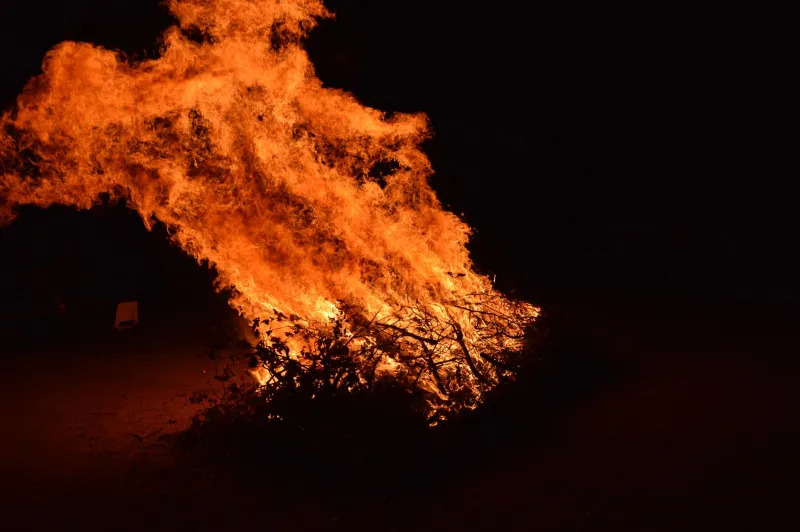
The final pyre is a costume drama too. Howie is not remade into a pagan offering; he remains recognisably the man in the uniform, law inside the wicker. That is what makes the image so durable. The clothes have already told us that he was always the sacrifice: the outsider whose uniform marked him as different, whose cardigan marked him as stubborn, and whose neatness marked him as a man who could not see that the island had its own dress code.
Watching The Wicker Man again in 2026, the songs still land and the ending still burns. But the wardrobe deserves its own closer look. The film's quiet system of moral coding is stitched into every button, badge and knitted sleeve. Clothes do not just make the man here. They help decide what he is for.