The Voice at the End of the Lane: Britain's Public Information Films Are Folk Horror's Missing Link
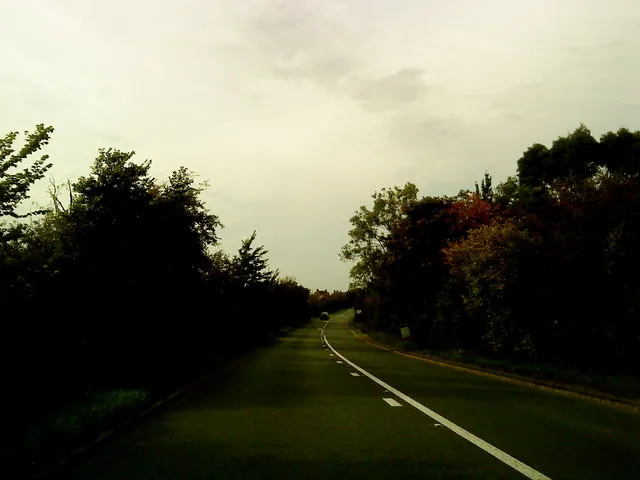
Photo: Andrew Abbott , CC BY-SA 2.0, via Wikimedia Commons
There’s a lay-by on a road I know where a sign once told me not to litter, and I can’t drive past it without hearing a voice that isn’t there. Flat, patient, faintly disappointed. The voice of a man in a cardigan, dead for decades, still asking me to look right, look left, look right again.
Public information films are supposed to be furniture. We grew up giggling at Charley the cat and the man bellowing ‘don’t!’ at a kid with a frisbee. But sit through a run of the rural ones — the reservoirs, the pylons, the farmyards, the gravel — and the furniture starts to move. These aren’t safety adverts. They’re dispatches from a country where the landscape wants you dead, the authorities are nowhere, and the only thing between you and a hole in the ground is a narrator who never once raises his voice.
Which, if you’ve seen The Wicker Man, is a fairly accurate description of Summerisle.
The Central Office of Information Never Blinked
The PIF was a peculiar invention: public money, advertising-agency craft, and a brief that amounted to ‘frighten them just enough to keep them breathing, but never admit that dying is on the table’. They were churned out in enormous numbers from the 1940s onwards, and the best of them share a house style — 16mm grain, overcast light, real locations, and a voiceover delivered like a shipping forecast read at a crematorium.
Watch ten in a row and you notice the grammar. A rule is stated. A rule is broken. A consequence arrives without commentary. Nobody is rescued. Nobody learns. The film simply stops, the way a folk song stops before the last verse.
Lonely Water: The Spirit of the Place
The daddy of them all is Lonely Water, made in 1973 for the Department of the Environment, directed by Jeff Grant and narrated — with obvious relish — by Donald Pleasence. Over shots of a grey gravel pit and a sluggish river, a hooded figure in rags croaks about the ‘spirit of dark and lonely water’, and then children drown, one by one, in silhouette.
It isn’t subtle. It doesn’t need to be. What makes it folk horror rather than mere caution is the premise: the water is a place with a will. The children aren’t punished for carelessness, they’re collected. Pleasence’s voice is the voice of the bog itself, and the state has hired it.
Apaches: Nobody Comes Over the Hill
If Lonely Water is the supernatural wing, Apaches (1977) is the documentary one. Directed by John Mackenzie — the man who’d go on to make The Long Good Friday — and produced for the Health and Safety Executive, it follows a group of children playing on a farm while, one by one, they’re taken by machinery, slurry and gates. It has been widely reported for decades that the film was considered too upsetting for general circulation; whether that’s gospel or folklore, it has settled into the same space as the rest of Britain’s whispered warning tales.
The ending is the thing. No moral, no closing card of reassurance. Just an empty field and the sound of children who were there a minute ago. It’s the same cut The Wicker Man pulls when the camera leaves the burning figure and the community carries on singing.
The Finishing Line: British Rail Goes Full Wicker Man
The Finishing Line (1977), directed by John Krish for British Transport Films, is the one that gets passed around every October now, and rightly. It stages railway deaths as a school sports day: children hurdle fences, sprint across tracks, and are picked off by trains in slow, queasy wide shots. There are rosettes. There’s a score. There are grown-ups clapping.
It’s a harvest festival with a body count. It’s also, quietly, one of the most formally adventurous films on this list — and the one that most clearly shows the genre’s shared DNA with folk horror: children given to the land, and a community that watches.
Protect and Survive: The Broadcast That Stayed in the Drawer
Protect and Survive is the odd one out, because it was never really meant for us. Produced for the Home Office in the mid-1970s and intended for transmission only in the run-up to a nuclear attack, it surfaced publicly around 1980 and instantly became a folk artefact: the state rehearsing the end of the world in a tone better suited to double glazing. Whitewash your windows. Build an inner refuge. Stay put.
The reason it unsettles now isn’t the bomb. It’s the assumption that there is a correct way to behave while everything ends, and that somebody up the chain has written it down and posted it through your door.
Why This Is Folk Horror, Not Just Nostalgia
Three reasons.
First, the landscape. The PIF’s Britain is the same Britain as The Wicker Man’s — causeways, reservoirs, hedges, gravel, coast in February. Second, the authority. In folk horror the village runs on rules you were never told about; in the PIF the rules are told to you constantly and they still don’t save you, which is arguably worse. Third, the sacrifice. Folk horror loves a child given to the land. So, it turns out, did the Central Office of Information.
And the missing-link claim isn’t just forum-cleverness. Look at what came after: the hauntological revival, Scarfolk’s fake council notices, the endless reuploads of Lonely Water under playlists called things like ‘do not watch alone’. Look at the texture of a Mark Jenkin film, or the way Ben Wheatley stages a field. All of it borrows the PIF’s central move — the calm voice describing an unthinkable thing in a place you recognise.
Look Right, Look Left, Look Right Again
The public information film is where British screen horror learned that a narrator can be scarier than a monster, and that an empty car park at dusk beats a crypt every time. It sits between Summerisle and the modern oddity, holding the door: the same country, the same flat tone, the same sense that you are being warned and welcomed at once.
Next time you’re on a quiet road and a sign tells you something obvious, listen for the voice underneath. It’s been there since before you were born, it knows your name, and it would very much like you to stay a little longer.