The Pub Is the Pagan Temple: A Folk-Horror Pub Crawl Round British Cinema's Strangest Boozers
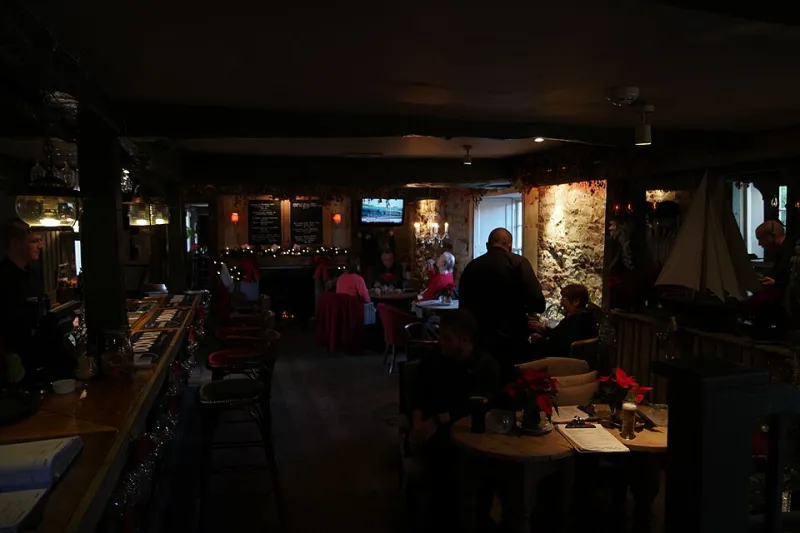
Photo: Bob Harvey , CC BY-SA 2.0, via Wikimedia Commons
British folk horror has never really trusted the church. The vicar is absent, mad, or complicit; the steeple is a silhouette. The actual place of worship, the room where the community assembles and the outsider is weighed, is the pub. It's where the rules are handed out, where the side-eye is administered, and where the last orders bell sounds uncomfortably like a curfew.
So here's a crawl — no route map, no app, just the boozers of cult cinema that do the genre's most unsettling work. First round's on the landlord. He's also the priest.
1. The Green Man, Summerisle — The Wicker Man (1973)
The altar with optics. The exterior belongs to the Ellangowan Hotel in Creetown, Galloway, though the film makes it somewhere further out and further back. Sergeant Howie walks in looking for a room and a missing girl; the room comes with a song about the landlord's daughter, a wall of maypole photographs, and a landlord who is cheerfully doubling as the island's religious authority.
What makes it the genre's definitive pub is the measuring. Everyone in the room knows exactly who Howie is and what he's for. He knows nothing. The pint is the interview and he fails it, and the film never has to say so out loud.
2. The Slaughtered Lamb, East Proctor — An American Werewolf in London (1981)
The template. Two students, one Yorkshire village, a warning not to stray from the road, and a bar that goes silent the instant a stranger says something he shouldn't. The pub isn't where the evil lives. The pub is where the rules are issued, and where breaking them gets you escorted out into the dark.
John Landis' nerve is making "keep off the moors" sound like ordinary closing-time conversation between people who have done this before. That's the whole folk-horror transaction in one deleted scene's worth of pub chatter: the community knows, the visitor doesn't, and nobody is going to spell it out.
3. The inns of Witchfinder General (1968) and Blood on Satan's Claw (1971)
Michael Reeves' film runs on taverns — low ceilings, jugs of something brown, and men doing rough arithmetic about who should be accused of what. Piers Haggard's film trades in village gatherings that curdle quietly in the corner of the frame. Neither treats the pub as sanctuary. Both treat it as the administrative office of the horror: the place where rough justice gets agreed, and where a woman can be seized over a serving dispute.
That's the point worth holding on to. In folk horror, the pub doesn't protect you from the village. It is the village, with a fire on.
4. The eleven pubs of Newton Haven — The World's End (2013)
Edgar Wright and Simon Pegg made a folk-horror film and declined the label: a homecoming, a village whose population has been quietly homogenised, and a rigid ritual — twelve pubs, one route, one finishing point — that has to be completed or the whole thing falls apart. The pints are the liturgy. The bar staff are the management. Even the names run together into a chant: The First Post, The Old Familiar, The Cross Hands, The Good Companions.
It's the funniest entry on this crawl and arguably the bleakest, because the horror isn't a cult in the woods. It's a high street where everyone has agreed to be the same.
5. The village bar in Calibre (2018)
Matt Palmer's film sends two lads from Edinburgh to a Highland village for a hunting weekend, and the pub is the only room in which they can be visibly outsiders. There's no robed ritual here, no maypole — just hospitality that operates as a negotiation and a welcome with conditions attached. The pint becomes a test of nerve, and the silence around the table does more work than any monologue.
6. The snug, wherever it is
Every British cult film with an outsider and a village has one of these rooms, and the lesser-known entries are often the more unnerving because the pub isn't dressed for drama. It's just a carpet, a fruit machine, a fire exit sign, and a dozen people who have decided something about you before you've ordered.
Last orders, 2026
Here's the wrinkle. Hundreds of British pubs have come off the register across this decade, and the ones that go first are exactly the ones folk horror films love: the isolated village boozer, the one-room free house, the place with a landlord rather than a manager and a rota of regulars who all know each other's business.
Watching these films now is a different experience to watching them even a few years ago. The screen shows us a room we're steadily losing: the communal space where the community performs its own rituals, benign and otherwise, and where an incomer is assessed within thirty seconds of the door swinging shut.
That's why the pub works as folk horror's true altar. Not because it's safe, but because it isn't — because it's warm, and lit, and full of people who are being perfectly nice to you while deciding something you're not party to. Keep your appointment. And get the round in.