Milk, Matches and Your Whereabouts: The Village Shop as Folk Horror’s Quiet Intelligence Agency
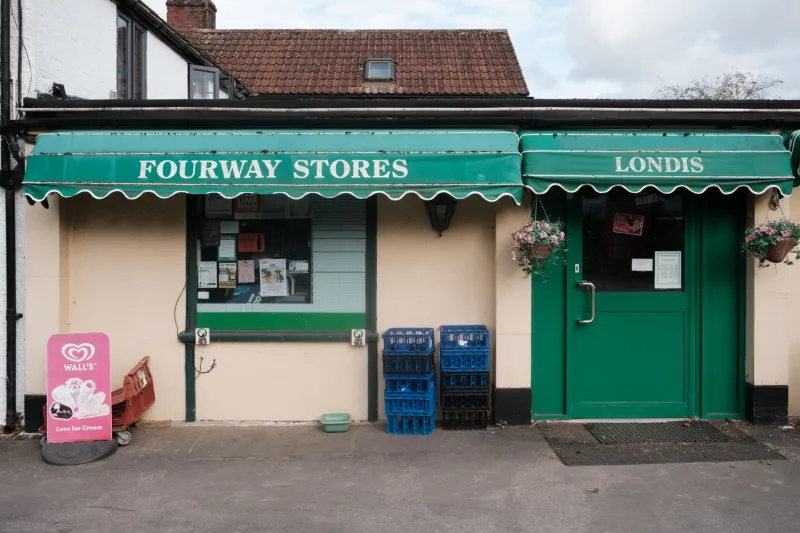
In most horror films, surveillance means cameras, screens and somebody in a van with headphones. In folk horror, it means a bell above a door and a woman behind the counter saying, before you have opened your mouth, 'You'll be the one in the cottage.' The village shop is not background dressing. It is the front desk of the whole operation.
The genius of the location is that it never has to announce itself as sinister. You go in for milk. You come out with milk, a local paper and the distinct impression that your movements have been noted in a ledger you will never see. That is the corner-shop conspiracy in its purest form: not a cabal of hooded figures, but a small retail premises that pays attention.
The bell is an intake form
A shop bell is a practical thing. It tells the proprietor someone has entered. In folk horror, it does something else: it gives the person behind the counter time to arrange their face. By the time you reach the till, your arrival has already been processed. The bell is not a welcome. It is an acknowledgement, and there is a difference.
Compare that with CCTV. A camera records you passively. A bell announces you to a human being who can look up, clock your coat, your car and your hesitation in front of the bread. The shop is an analogue system, but it is not a stupid one. It is a local intelligence network with a fridge cabinet.
In The Wicker Man, Summerisle's shop is not a place of spontaneous need. It is a stocktake of what the island permits. The shelves are curated, the supplies are managed, and the outsider's wants are anticipated just enough to be unsettling. The shop does not need to threaten Howie. It only needs to demonstrate that it already knows what he is likely to ask for.
Shelves as permitted inventory
What a shop stocks tells you what a community believes is necessary. What it refuses to stock tells you something worse. In rural folk horror, the absence of a familiar brand can feel like a border control. You ask for something ordinary and the reply is a polite 'We don't get that in here.' It is not a supply problem. It is a definition of belonging.
The village shop is a filter. It narrows the world down to local sausage, local honey, local gossip and a choice of two newspapers, one of which is always a week old. That narrowing is not just quaint. In folk horror, limited choice is a form of governance. If you cannot buy what you need, you become dependent on what is offered. And dependence is the first chapter of every folk-horror welcome pack.
Milk is the perfect test case. It is the most ordinary purchase in Britain. It is also a small declaration of domestic life: you have a fridge, you have a routine, you are staying. The shop notices. It always notices.
The noticeboard is the public ledger
The noticeboard by the door is folk horror's social media feed. Cards for a yoga class, a lost cat, a parish council meeting, a harvest supper, a piano teacher who has one slot left. It is public, but it is not transparent. Who pins things? Who removes them? Who decides that the missing-person poster has been up long enough?
In a village, the noticeboard is where private life becomes public record. A birth, a death, a jumble sale, a planning dispute. It is also where the film can plant a detail you will only understand later. The innocuous card for a village fete can sit next to a poster for a missing walker and neither looks out of place. That is the trick. Folk horror does not need to shout. It just needs to pin something to cork.
The shop is the natural home for that board because the shop is where the community already crosses paths. You cannot avoid the noticeboard if you want a pint of milk. You cannot avoid being seen reading it, either.
The proprietor as archivist
The person behind the counter is not usually the monster. They are more useful than that. They are the archivist. They know your brand of cigarettes, your newspaper, whether you take paracetamol with your shopping, and whether your car has been parked outside the holiday let for longer than the booking said. They do not need to be menacing. Their knowledge is the menace.
In British village life, the shop often doubles as post office counter, pharmacy drop-off, community notice point and informal advice bureau. That makes it a superb folk-horror location because it is already a place where official and unofficial information meet. The proprietor can ask after your family in a way that sounds kind and functions as a data extraction exercise. 'Your lot used to come here,' they say. 'Staying long?' You answer without thinking. By the time you leave, your stay has a shape, and they have the shape.
Why the shop and not the pub?
The pub is where people perform. The shop is where people need. You go to the pub to be social; you go to the shop because you have run out of bread. Folk horror is always more interested in need than performance. The shop sees you in your ordinary, unglamorous state, buying the things that keep a body going. That is a vulnerable place to be seen.
It is also why the shop can be more unsettling than the village hall or the church. Those places have announced purposes. The shop is supposed to be neutral. It is supposed to be a transaction. When it becomes something else, the familiar ritual of buying milk turns into a quiet interview.
The conspiracy, in the end, is not a secret meeting in a barn. It is a bell, a noticeboard and a proprietor who says, 'You're leaving, then?' before you have told them. You came in for milk. You leave with a receipt and the sense that the receipt has been filed.