A Coat on a Cross: Why the Scarecrow Is Folk Horror's Most Patient Witness
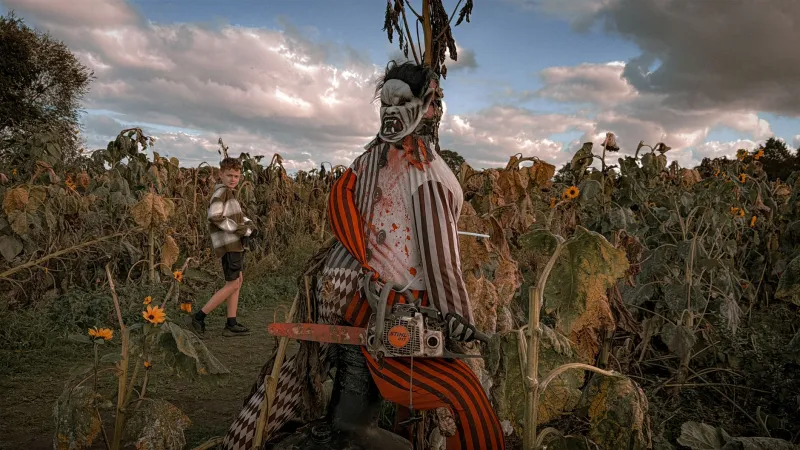
There is a certain sort of quiet that settles over a field with a scarecrow in it. It is not the silence of an empty place. It is the silence of a place with a witness. You notice it after you have already driven past, or after the dog has stopped sniffing, or after the light has gone flat. And then you look back and it is still there, still facing the wrong way, still wearing somebody's old coat.
British folk horror has always been fond of edges: the last house before the moor, the gate at the end of the lane, the pub that marks the boundary between village and field. The scarecrow is an edge made upright. It belongs to the field but stands at the field's limit. It is agricultural equipment and human silhouette at the same time, a practical object that cannot stop looking like a person.
The field's unpaid employee
Start with farming, not folklore. Scarecrows are bird scarers, a way of keeping crows and pigeons off newly sown seed. They have regional names across Britain: mawkin in parts of Sussex and Kent, tattie bogle in Scotland, gallybagger on the Isle of Wight. The basic construction is a cross, a sack, a hat and cast-off clothes. The farm's own wardrobe gets a second life in the open air.
That is why the scarecrow is so useful to horror. It is mostly not an ancient pagan idol. It is rural improvisation: string, straw and a shirt that used to belong to somebody. But that is exactly where the unease begins. Familiar clothes with no body inside. A hat that suggests a head. A sleeve that moves in the wind but does not reach for anything. It marks the agricultural year, from sowing to harvest, and then it often remains after harvest, a coat on a cross in a bare field. The job is over. The shape stays.
Why the human shape is the problem
We are built to read faces and posture. A scarecrow gives us just enough to start: shoulders, hat, sleeves, maybe a painted grin or a sack with no features at all. Pareidolia does the rest. A coat on a cross can look crucified. A sack can look hooded. A hat can look like a person turning away.
Horror lives in the pause. A scarecrow does not lunge. It waits. That is worse. It is a monster that has mastered deadpan. You can outrun a pursuer; you cannot outrun being looked at. The scarecrow is unsettling because it is still, and stillness in a living landscape reads as intent. It is not doing anything, which means it might be about to.
The wrong way round
Scarecrows are usually meant to face the field, not the road. From the lane, that means it has its back to you. Fine. But in folk horror, the interesting moment is when it seems to have turned. Not moved, exactly. Just somehow reoriented. The village has placed it there not only to frighten birds but to mark a boundary. Beyond this point, you are in their field. The scarecrow is the village's way of telling you that you have been seen. It is surveillance in a flat cap.
That is the folk-horror trick. The scarecrow is rarely the monster. It is the village's alibi. It was there all along, and it saw everything. It gives a lonely field the feeling of a room with somebody else in it, somebody who does not need to speak because the arrangement of the coat and the angle of the hat have already said enough.
Screen scarecrows and rural uncanny
On screen, scarecrows are cheap and effective. They do not need CGI; they need weather and a fixed shot. Worzel Gummidge is the obvious British telly example, and it remains deeply odd for a children's programme: a walking scarecrow with interchangeable heads, a rural labourer who is also a body without a fixed self. Doctor Who used scarecrows as foot soldiers in 2007's Human Nature / The Family of Blood, and they work because they are stiff, silent and dressed like farmhands. American cult cinema has its own line: Dark Night of the Scarecrow (1981), Scarecrows (1988), Husk (2011). The Wicker Man has no scarecrow, but its final image is the same idea at cathedral scale: a human-shaped thing built to be looked at and burned. The village makes a body into a symbol, and the symbol does the work.
Warning, witness, or noticeboard
There are three useful readings. The scarecrow as warning: stay out of the field. The scarecrow as witness: it saw you climb the gate. The scarecrow as noticeboard: the village is advertising its own control of the land. In most folk horror, the scarecrow is not supernatural. The horror is social. It is the parish council's stare given a coat. It is the thing that makes a quiet field feel patrolled.
And because it is mute, it never has to explain itself. It does not threaten. It does not negotiate. It simply stands there, facing the crops, or the house, or the lane, depending on which way you look at it. The scarecrow is folk horror's most patient witness because it never leaves the scene. It just waits for you to realise you are already in it.